Wednesday, June 29, 2011
So something nice that i saw while watching the first match of the year over again. Team 1727 D used a conveyor cage but to make the objects come out towards the goal they had one hard flap to push the piece through (at least it looked like it). if what i am working on fails that is definatly possible

Modified Claw
Not much of an update, just that the claw concept has been modified and is nearly ready to be tested. Both drive bases are nearly finished as well with mechanism construction taking priority now.


Monday, June 27, 2011
C-Drive Base Drive Test
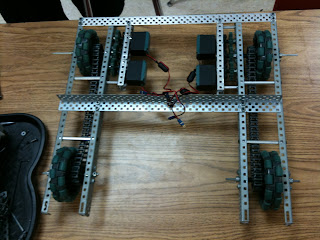
This video was taken last Saturday. We call it the C-drive base and one of the nice advantages that it has is the ability to pivot around game objects to allow manipulators to grab the game objects from the correct angle or side.
Friday, June 24, 2011
Drives Nearly Finished and Conveyor Mechanism Prototype (with video)
The team has been meeting all this week during the day to help run the Lego camp for younger aged students. During the evenings, we are still working on finishing the two drive systems which are nearly complete. Thanks to Radnor Robotics who let us borrow their game field and border for practice.


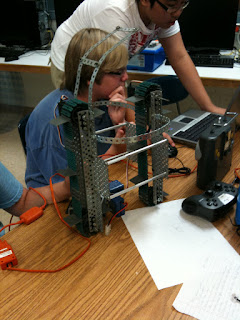
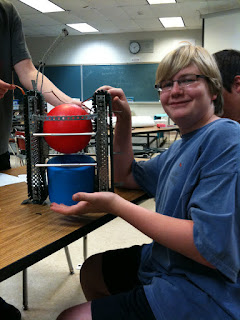
Ranier worked on getting his conveyor belt concept up and running. The initial sketch was shown in a previous post. It currently uses a belt on each side to move the game objects up and down.
Below is a video of the first test -


Ranier worked on getting his conveyor belt concept up and running. The initial sketch was shown in a previous post. It currently uses a belt on each side to move the game objects up and down.


Below is a video of the first test -
Sunday, June 19, 2011
Carpet Day & Lego Camp
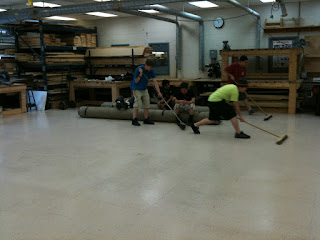
The team took some time off from VEX on Saturday to organize the wood shop room. This is done every summer so that students can practice driving the previous year's robot and actually learn how to drive a mecanum drive system.
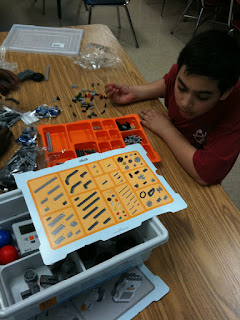
The rest of the students worked on assembling Lego game field pieces for a summer camp being run by Team 357. Each week students will be able to come to Upper Darby High School and get to build Lego NXT robots under the guidance of our teachers and students.

The claw shown in a previous post has begun to be manufactured and it is looking promising. It can pick up both a barrel and a ball individually and it can also pick both of them up if they are stacked.

Look for more updates this week!

The rest of the students worked on assembling Lego game field pieces for a summer camp being run by Team 357. Each week students will be able to come to Upper Darby High School and get to build Lego NXT robots under the guidance of our teachers and students.


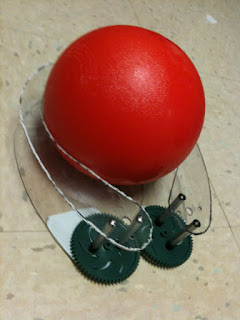
The claw shown in a previous post has begun to be manufactured and it is looking promising. It can pick up both a barrel and a ball individually and it can also pick both of them up if they are stacked.


Look for more updates this week!
Friday, June 17, 2011

Thursday, June 16, 2011
Lesson on Torque and More Brainstorming
Updated By: Michael Pereira
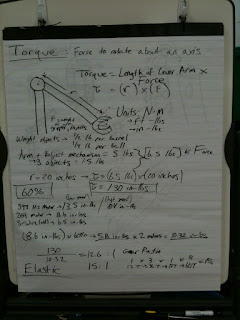
Today team 357 had a mini-lesson about Torque. (Torque = Length of Lever Arm x Force [ t= (r) x ( F) ]. This is important to figure out the appropriate gear ratio to account for when designing our mechanisms. Using the formula for torque, we can determine how heavy and large our mechanisms can be without risking destroying our motors in the process.
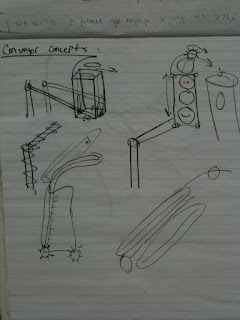
After the lesson on torque, we discussed possible mechanisms to use for this year's competition. They included specifically a conveyor system on a 4-bar arm and a claw mechanism attached to a 4-bar arm.

After that we had split off into our separate groups and worked on different parts of the robot.
Some worked on the H-Drive and a member, Evan, completed the C-Drive prototype drive base. Two members of the team began working on a conveyor-belt system for a mechanism.


More photos after the break!
Today team 357 had a mini-lesson about Torque. (Torque = Length of Lever Arm x Force [ t= (r) x ( F) ]. This is important to figure out the appropriate gear ratio to account for when designing our mechanisms. Using the formula for torque, we can determine how heavy and large our mechanisms can be without risking destroying our motors in the process.

After the lesson on torque, we discussed possible mechanisms to use for this year's competition. They included specifically a conveyor system on a 4-bar arm and a claw mechanism attached to a 4-bar arm.


After that we had split off into our separate groups and worked on different parts of the robot.
Some worked on the H-Drive and a member, Evan, completed the C-Drive prototype drive base. Two members of the team began working on a conveyor-belt system for a mechanism.


More photos after the break!
Subscribe to:
Posts (Atom)